A WALK ON THE WILD SIDE…
by Ann Cremin
Lyon, June 2013
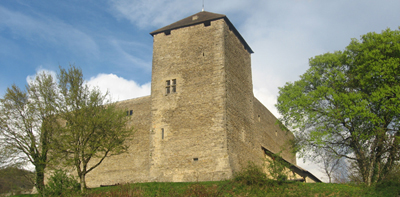
 One of the advantages of living in Lyon is that you are basically at the very heart of Europe – whichever direction one chooses, one comes across fragments of French history. The other day, I ventured as far as Ambérieu-en-Bugey , and from there wended my way up hill to the medieval Château des Allymes . An impressive stronghold built at the very top of the hill, overlooking the vast plains of Savoie. It was built in the 14th century, as a fortress by the Dauphiné against the Savoie region. In 1601, the castle was handed over to France when Henry IV attached the Bugey district to the kingdom of France. It underwent many structural changes and went from being a fortified military outpost to a full blown family château. It was classified as Monument Historique in 1993 and is run by the city of Ambérieu and the Association des Amis du Château. It is host to an impressive list of happenings, conferences and visual art exhibitions.
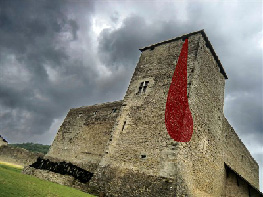
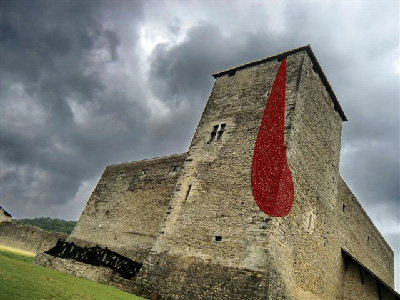
 That was the reason I went there, to see a very interesting and original show by the Lyon-based artist Alain Boulerot. He is a talented artist whose work encompasses many different disciplines. He was first noticed as a painter, and then developed his own very personal approach to photography. The exhibition in the Château des Allymes came about as a result of a childhood experience. « I had been there as a child and it had impressed me at the time, by its bulk and character. On seeing it again a couple of years ago, I was once more overwhelmed. You find yourself facing the château like you would a parental figure. » To Alain, as a child, the solid stone building seemed the epitome of masculinity, unchallenged, secure in its own belief. On the other hand, the inside summed up feminity, with its dark nooks and winding passages. Hence the title of the exhibition: « L’origine du monde ».
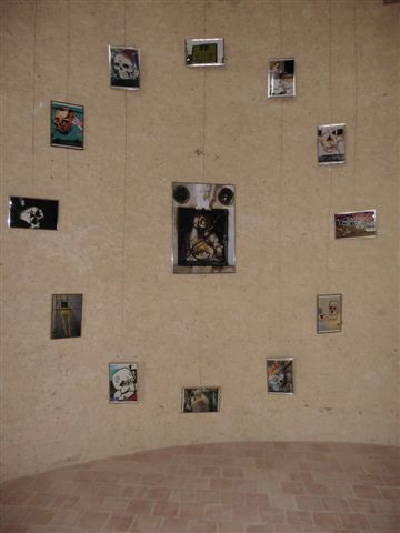
The exhibition in fact is a visit within the innards of the castle, where each work relates precisely to its positioning. For instance the photographs of landscapes within an enclosed space with a narrow window summons the query as to what the soldiers, keeping a look-out for potential disturbances, imagined was happening in the big beyond. The artist also explains that the « ephemeral souls »: i.e. fleeting images of masks on a Seventies nail plank, are imaginary, or imagined, portraits of those anonymous guardians. The works vary according to the space where they are shown, thus creating a very personal dialogue with the space itself. The artist explains « My wish was to invest that space without betraying it nor invading it. I wanted to place passageways between what remains of the architecture and its original function. » In other words, the very bases of the building implying as it did protection, safety and a certain spiritual dimension : leading to a life given over to solitude, faith, and hope.
Apart from its purely militaristic function, the castle also boasts living areas, faithfully restored, such as a library, furnished with maps, books, and an imposing fireplace. All of the areas have been invested by Alain Boulerot who has treated each part of the castle as a separate entity for which he designed specific objects, like the round floor piece, in one of the towers. All in all well worth seeing for the many different « readings » to be made of the place and of the artist’s own, very singular, approach.
 Back in the big city, the MAC (Musée d’Art Contemporain) is showing an all encompassing exhibition, with three broad themes: a history of the actual museum and its collections, entitled « Pour Mémoire », as well as two one-man shows, one by Philippe Droguet, the other by Daniel Firman. The « historical » part is based on five important dates the creation of the contemporary art museum in 1984, a show in 1988 that opened up the way for the Lyon Biennale in 1991, the setting up of the museum in the Renzo Piano building in 1995 and the latest Biennale of 2011.
Very well set out, as usual in this museum, each artist has been allotted a unique space, allowing the presentation of one or several works. These included a splendid piece by Anish Kapoor, « Mother as a void » from 1988. This large ovoid shape, an almost black, blue empty shell, summons both the woman’s womb before giving birth and the void remaining after expelling the fetus. The artist himself said: « its blue robe identifies it as a cosmic mother, an initiator. I see the void as a potential space, in some ways, rather than as a non-space ». The visitors approached it almost fearfully as if afraid of being trapped within its infinite space. There is a fascinating video by the Belgian artist Carsten Höller, very unusual. The artist was originally an entomologist and in the course of his studies on communication among insects, he came across an unusual story told about an Austrian legend where an enamored nobleman taught the finches in his garden to sing a love song to his beloved. The finches of next generations went on singing this same song. Entitled « Lover Finches » it is certainly unexpected in such a rarefied context. Another fascinating video is that of the South African artist Tracey Rose, “Happy Hope” where the artist is shown at the base of the wall between Palestine and Israel, singing a song of hope; she is provocatively dressed in virulent pink underwear, with fishnet tights and her body is covered in flashy pink paint.
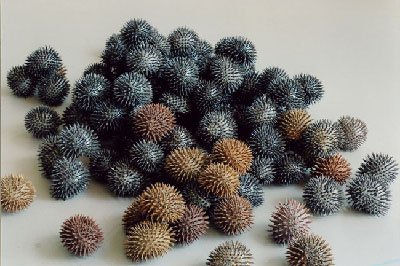
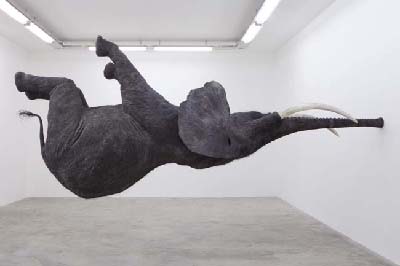 Alongside the « historical » reminders are the two one-person shows: Daniel Firman’s show is entitled “La Matière grise” and is a series of installations, some of them prosaic household objects, others more disturbingly featuring a young woman whose face is buried in the wall, a life-size elephant in mid-air, a sculpture such as “Le Feu”. This is made up of a heap of logs, made of bronze, with fire escaping from a gas jet. The other one-man show is that of Philippe Droguet, entitled “Blow up”, as a homage to Antonioni. The works are made up of seduction/repulsion – where nothing is as it first appears. In the distance “Fléau” looks like a friendly furry little creature that turns out to be made from snail shells coated in sharp spikes. « Tombés », seen from afar look like free floating pieces of canvas, but they have been soaked in paraffin and applied in various layers until they look like fragments of marble, or of alabaster. And so it goes on – the show really gives one furiously to think. Nothing is what it appears at first glance.
All in all, a fascinating overwiew of the museum’s activities and choices over the past twenty-five years.