HOORAY FOR BELGIUM!!!
by Ann Cremin
I recently took a little trip to Brussels to visit the exhibition Changing States, devoted to Irish art in honor of Ireland’s status as president of the UE for six months. I was favorably impressed by the whole undertaking – held in the very heart of Brussels in BOZAR – or Palais des Beaux Arts - it provided an interesting reading of the visual arts situation in Ireland to-day. Broad in its scope, it covered the many facets of current art forms : installations, sculptures, paintings , drawings and videos.
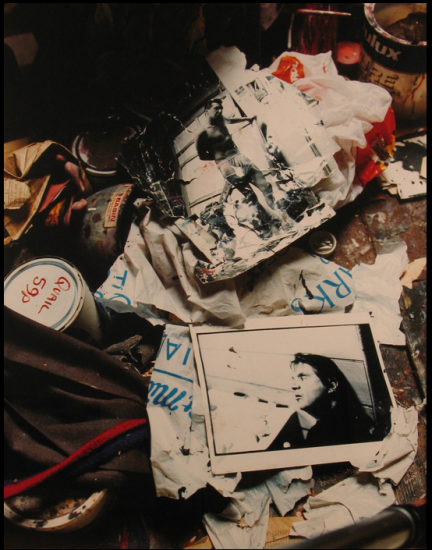 One of the most pertinent exhibits was the Francis Bacon studio, carefully transported from the Municipal Gallery in Dublin.
As one of the outstanding and influential artists of the 20th century, Bacon is not often associated with Ireland – he was born there in 1909, the son of a retired British officer who moved there in order to breed horses. The family moved back definitively to England in 1924 to avoid « The Troubles ». In fact Francis Bacon never returned, being based chiefly in London where the famous studio was located But he retained fond memories of Ireland and once explained that the bow window featured in many of his paintings was based on his family’s house in Co Kildare. He was a close friend of Louis Le Brocquy and of his wife Anne Madden until the end. After his death, his studio found its way to Dublin where it has been ever since. It is a work of art in its own right, filled with the jetsam and flotsam of fifty years’ unrelenting pursuit of the unattainable, and thus provides a fascinating glimpse into someone’s mind and creativity. Everything is there, the magazines, the books, the scraps of newspapers, old photographs of various icons of Bacon’s day. Alongside are presented many works, including a series of the well-known Muybridge inspired paintings, as well as portraits of his friends and lovers.
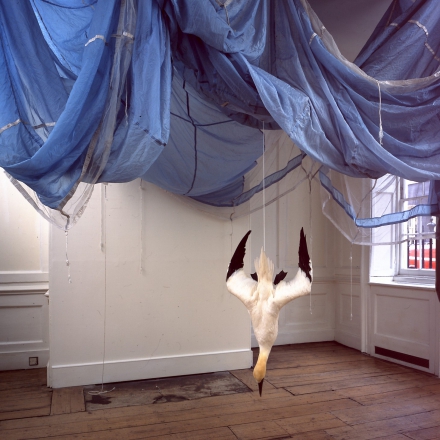 The other rooms offer a broad panorama of current Irish artists’ preoccupations – a very striking sculpture by Dorothy Cross “Parachute” is given its own space, in which a gannet is suspended beneath the folds of a parachute, heading towards the ocean. Alongside, in a separate space was a large installation by Eva Rothschild, entitled “Stalker”, on the verge of toppling over. The black Perspex material and wooden underpinnings managed to induce almost a feeling of vertigo. Another fascinating exhibit was a video by Willie Doherty, entitled “Ancient Ground”, it lingers over a peat bog, in Donegal, where the land and water intermingle and overlap. The excellent voice-over is a stream of consciousness piece, reflecting in every sense, the interaction of land and liquid, like the embodiment of memories, not all of them pleasant, and regrets…
Another successful visit on the same day was that of the Magritte museum, quite close to the Beaux-Arts, on the place Royale. Covering three floors, it contains the largest collection in the world of works by the famed Belgian artist, renowned for his many provocatively entitled paintings. Extremely well produced the many rooms provide an overall history of the artist’s artistic cursus. Very early on, Magritte shows signs of his surrealistic approach to the world around him, whether in photographs, drawings or cartoons. Seeing the complete works, it is fascinating to realize the impact he still has on current images – his visual approach, objective and yet slyly ironic, his manner of turning the most banal object – a pipe, an apple, a flying bird – into something inherently other…. Over and over again, I kept being reminded of contemporary movie posters, or advertising campaigns. One also finds there the series Magritte painted very rapidly for an exhibition in Paris that he did not want, and for which he produced almost “pastiches” of his own work “just to annoy the Parisian intellectuals”….Highly invigorating and entertaining – definitely well worth another visit. The hanging is very precise, subtly lit, with no show-off effects.
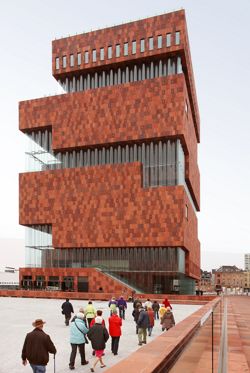 Another discovery during the week-end was the recently built MAS museum in Antwerp. It is an amazing building, ten levels’ high, which took nearly five years to complete ( 2007-2011). Its architecture defies description with winding esplanades, shimmering glass facades and wavy transparent outer roofs. Its aim is to emphasize Antwerp’ place as the second largest port in Europe. In fact, it encompasses three museums in one, which lends it a timeless ambience, an outside time experience. These are chiefly a Maritime Museum, a museum devoted to the former colonies in Africa and the Americas, and the constituent museum of Antwerp’s own urban history as the historical focus for maritime traffic throughout the centuries. An impressive series of rooms present a collection of Pre-Columbian art, on a long-term loan from the Flemish government.
The sheer scale of the various collections means that one must go back several times, in order to enjoy fully the richness of the objects and documents assembled there. By outlining each area’s specificity, it is possible to choose which one to visit thoroughly, and then return another day to see the next layer of offerings. Basically, it a visual history of the port and how it catered to all of Europe over the centuries. Because it has been carefully thought out and planned, one can bypass whole areas without feeling “guilty” – each floor is self-sufficient. t
The Irish Eyes thanks Thalys.