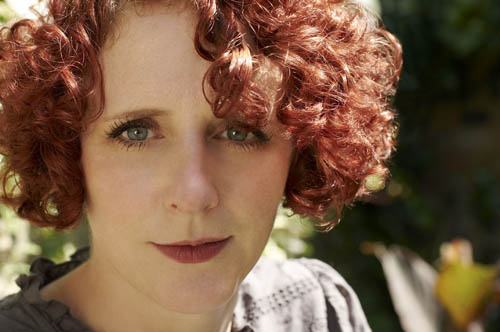
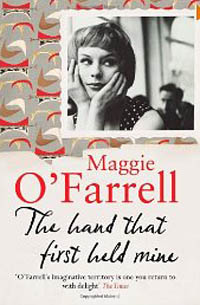
 Maggie O'Farrell won the COSTA Novel Award 2010 with her fifth book, "The Hand That First Held Mine". At first this book seem to tell two stories. The narrative switches back and forth between the adventures of Lexie (a headstrong young woman in the Soho art scene of the 1950s) and the home life of a young couple today, Elina and Ted, who are struggling to adapt to life with their new baby. How the parallel stories are connected remains a mystery for most of the book. Maggie O'Farrell won the COSTA Novel Award 2010 with her fifth book, "The Hand That First Held Mine". At first this book seem to tell two stories. The narrative switches back and forth between the adventures of Lexie (a headstrong young woman in the Soho art scene of the 1950s) and the home life of a young couple today, Elina and Ted, who are struggling to adapt to life with their new baby. How the parallel stories are connected remains a mystery for most of the book.
Jean O'Sullivan (for The Irish Eyes) spoke to Maggie O'Farrell recently when she was in Paris.
The Irish Eyes : I was struck by the vividness and accuracy of your description of life with a new baby. At one point you write that: "The shock of motherhood for Lexie is not the sleeplessness, the troughs of exhaustion, the shrinkage of life, how your existence becomes limited to the streets around where you live, at the onslaught of domestic tasks: the washing and the folding and the drying..." You don't often read about this in novels.
Maggie O'Farrell : I wanted to write about the effect a baby has on the life of a couple. Having a baby is very disorienting and exhausting. That aspect hasn't been described very much in novels. Having a child also has the effect of bringing back your own infancy - the way songs and other memories eturn - so I wondered what if these things, these memories are unfamiliar? This provided the central intrigue of the book.
 T.E.I.: The other strand of the book is the vivid character of Lexie and the exciting life that she leads in Soho in the 1950s among the artists and writers. It's quite a contrast. T.E.I.: The other strand of the book is the vivid character of Lexie and the exciting life that she leads in Soho in the 1950s among the artists and writers. It's quite a contrast.
M.O.'F.: I liked the idea of a young girl arriving in London to reinvent
herself. So I created Lexie and some other characters and fit them into that period, with people and places that actually existed.
T.E.I.:: Why did you choose Soho?
M.O.'F.: I went to see an exhibition in Edinburgh of John Deakin's photos of Soho in the 1950s and I was mesmerised - there was an odd stillness to them that I liked. I got interested and began reading up about that period. I think the great thing about cities is that there are certain places which have a strong tradition of reinvention, and Soho is one of the places that reflects that. It was originally the royal hunting grounds, then later became the immigrant quarter, then had its heyday as a bohemian artistic centre.
T.E.I.: You were born in Northern Ireland and grew up in Wales and Scotland - it's a bit like having the British Isles in one person!
M.O.'F.: Yes - but we were only living in Northern Ireland for six months so it was just a coincidence that I was born there. My family comes from Dublin and most of my ties are in Ireland. We moved to Wales and then Scotland but we always returned to Ireland every year and spent our summers in Dingle and Connemara. I have an Irish passport.
T.E.I.: The whole motherhood theme sounds like it comes from experience...
M.O.'F.: Yes, it does. I've even heard of women giving the book to their
husbands to read... My son is seven and my daughter is now two so you could say I'm only now "coming out of the tunnel"!
|